
A small group NLP training is a certification course capped at a handful of participants — in practice, ten people or fewer — so that everyone gets watched, corrected and coached while they actually run the techniques. Group size matters more than almost any other feature you can compare, because NLP is a behavioural skill: you learn it by being observed doing it, not by listening to it explained to a room of eighty. This guide explains what “small” really means, why the number changes what you walk away with, and the honest trade-offs of a small room.
| The short version | |
|---|---|
| What it is | An NLP certification course capped at roughly 10 or fewer participants |
| Why it matters | NLP is a practised skill; small groups mean you’re seen and corrected every time |
| Typical large group | 30–100+ people, demos from the stage, little or no individual feedback |
| Main trade-off | Fewer peers to practise with and often a higher price per seat |
| Best for | Anyone who wants to use NLP with clients, teams or themselves, not just understand it |
What counts as a “small group” in NLP training?
There’s no regulator that defines it, so “small group” is a marketing phrase until you ask for a number. As a working rule, a genuinely small NLP training seats around ten participants or fewer with one lead trainer — few enough that the trainer can name everyone and watch each person run a technique at least once a day. Once you pass roughly fifteen to twenty, feedback becomes something you queue for rather than something you receive.
Be wary of the middle ground that borrows the language of both worlds. A course advertising “personal attention” for forty people, or one assistant per twenty participants, is a large group wearing a small group’s clothes. The honest question to ask any provider is simply: how many people will be in the room, and how many trainers?
Why does group size change what you actually learn?
Because NLP is caught in the correction, not the lecture. A pattern like anchoring or calibration looks simple when demonstrated and falls apart the first few times you try it — your timing is off, you miss the subtle change in the other person’s face, you talk over the moment that mattered. The value of a course is a trainer catching that specific mistake, in your hands, and adjusting it on the spot. In a room of eighty, that correction never reaches most people; they leave with a certificate and a vague sense of the technique.
Small groups also change the exercises themselves. Many core NLP drills need a partner whose reactions you read in real time, and a facilitator circulating to spot what you can’t see about your own delivery. With fewer pairs to cover, the trainer reaches every one of them several times. That’s the difference between watching NLP and being able to do it under pressure.
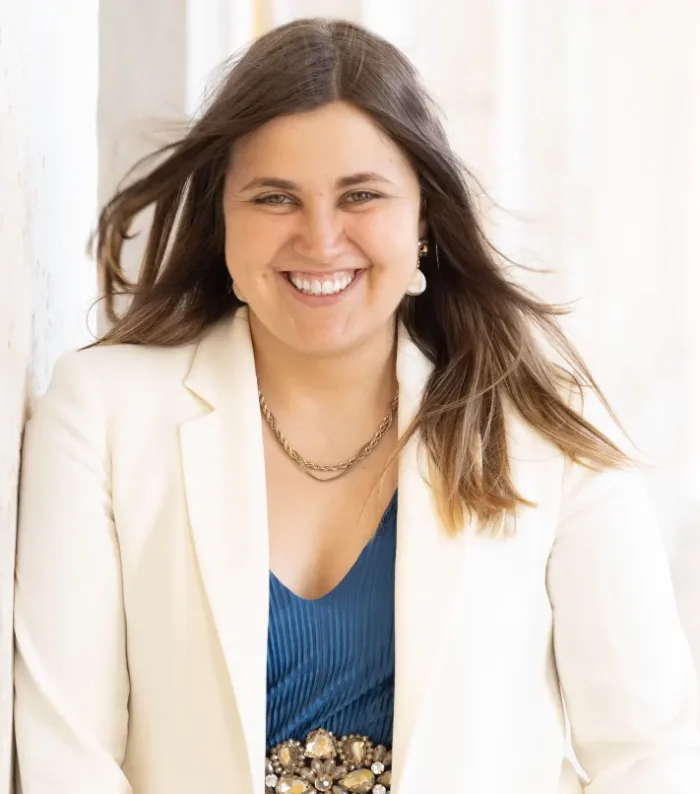
In the trainings I run in Lisbon, capping the room at ten is a deliberate constraint, not a scheduling accident: it’s the largest number where I can still watch each person work every day and correct them by name. — Carolin Mallmann, Licensed Trainer of The Society of NLP, Lisbon
What can a small group do that a large one can’t?
A small room makes a few things possible that simply don’t scale. Each one maps to a reason people say the week finally “clicked” for them.
- Individual correction. The trainer sees your specific error — not the average error of the room — and fixes it while you’re making it.
- Real practice time. With fewer people, more of the day is spent with a technique in your own hands rather than watching someone on stage.
- Psychological safety. People try clumsy first attempts — and the vulnerable change work NLP involves — far more willingly in front of nine peers than ninety.
- Adaptation to you. A trainer can slow down on the pattern your group struggles with and skip ahead where you’re already fluent.
- Accountability. In a group of ten, you can’t hide in the back; that pressure is uncomfortable and it’s exactly what builds skill.
Are there real downsides to a small NLP training group?
Yes, and any trainer who says otherwise is selling. A small group has honest trade-offs worth weighing before you book.
| Small group (≤10) | Large group (30+) |
|---|---|
| Individual feedback every day | Feedback mostly from the stage |
| Fewer practice partners to vary with | Wide variety of people to practise on |
| Usually higher price per seat | Lower price, economies of scale |
| Nowhere to hide — intense | Easy to observe passively |
| Depends heavily on the one trainer | Often several trainers and assistants |
The two that matter most: variety and price. A big cohort gives you dozens of different people to test a technique on, which is genuinely useful, and it costs less because the trainer’s time is spread thin. A small group asks you to pay more for depth over breadth. If your goal is to skim NLP as a concept, a large or even online course may serve you better — we cover that choice in detail in our comparison of online versus in-person NLP training. If your goal is to leave able to run the patterns cleanly, the depth is the point.
How small is small enough — and what should you ask?
Somewhere around ten participants is the practical ceiling for daily individual feedback with a single trainer. Below that it only gets more personal; above it, the maths of attention stops working. Before you book any course marketed as “small” or “intimate,” get concrete answers to these:
- What is the maximum number of participants — not the average?
- How many lead trainers and assistants are in the room?
- Roughly what share of each day is hands-on practice versus lecture?
- Will the trainer watch me run techniques and give me personal correction?
- Who issues the certificate, and is it tied to a recognised body?
That last point matters as much as size: a tiny group taught toward a certificate nobody recognises still isn’t worth it. If you’re unsure how to read a provider’s promises, our guide to the red flags when choosing an NLP course covers what to check. The training we run — a seven-day NLP Practitioner certification in Lisbon — caps the room at ten for exactly the reasons above, and issues a licensed certificate through The Society of NLP.
Frequently asked questions
How many people is too many for an NLP training?
Once a course passes roughly fifteen to twenty participants per trainer, individual feedback becomes something you wait in line for rather than receive regularly. For a skill-based subject like NLP, around ten or fewer is the point at which a single trainer can still watch and correct everyone each day.
Is a small group NLP training worth the higher price?
If you intend to actually use NLP — with clients, a team, or on yourself — then yes, because the correction and practice time a small room provides are what turn theory into usable skill. If you mainly want to understand the ideas, a larger or online course at a lower price may be the better value.
Do small groups mean a lower-quality certificate?
No. Group size and certificate quality are independent. What determines a certificate’s value is the body behind it and the trainer’s licence, not how many people were in the room. Always check who issues the certification separately from checking the group size.
Can you really learn NLP in a large seminar?
You can absorb the concepts and see impressive demonstrations, which many people find inspiring. What large seminars struggle to deliver is repeated, personal correction of your own technique, which is the part that builds competence. Many people attend a big event and then seek a small group to actually gain skill.
How big are the NLP Practitioner groups in Lisbon?
The English-language NLP Practitioner trainings in Lisbon are capped at ten participants, so every person is watched and coached through the techniques each day of the seven-day course. The cap is deliberate — it’s the largest number that still allows individual correction by name.
Keep exploring
- What happens at an NLP Practitioner training — a day-by-day look at the teach, demo and practise loop a small group makes possible.
- The fastest way to get NLP certified — how the intensive seven-day format works without cutting the corners that matter.
Carolin Mallmann — Licensed Trainer of The Society of NLP, trained by Richard Bandler. She has trained 300+ people and runs English-language NLP trainings in Lisbon in groups of no more than ten.